

| SCHOOL OF STUDIES IN ZOOLOGY |
1. Programmes Offered
(a) M. Sc. Zoology
(b) M.S.c (Molecular and Human Genetics)
(c) M. Phil. Zoology
(e) Ph. D.
2. Profile of the Department
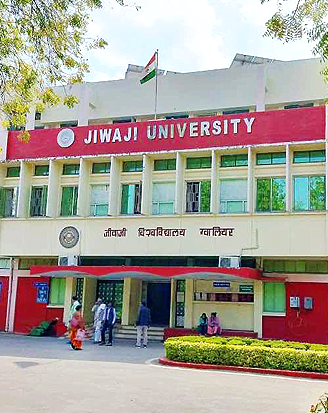
The School of Studies in Zoology was established in 1971 as one of the
teaching departments of the Jiwaji University. The mandate of the School
is to conduct teaching and research programmes leading to M.Sc., Ph.D.
and D.Sc. degrees in Zoology. The specilizations offered at M.Sc. level
are Aquatic Ecology and Aquaculture, Endocrinology, Entomology, and Cell
and Molecular Biology. The Department has initiated following self-supporting
courses which have already gained good reputation:
a) PG Diploma in Clinical Pathology & Diagnostic Technology
b) M.Sc. in Neuroscience
The School has got well qualified and trained (in India and abroad) faculty.
The School is well known for excellent research work in various fields
of Zoology and allied disciplines. The Department has established several
national and international collaborations. Most of the faculty members
have visited other countries for conducting their research work and for
participation in international seminars/symposia/conferences/workshops
and other academic activities under various programmes. More than 25 research
projects have been sanctioned to the School by various agencies like UGC,
DST, DAE, DRDO, DOE, ICMR, ICAR, MPCST, etc. and approximately grants
worth one crore of Rupees have been received so far. A good number of
candidates have completed their research work from the School and have
obtained D.Sc. (one), Ph.D. (<100), and M.Phil (56) degrees. At present
2 Post-Doctoral Research Scholars and around 20 Ph.D. Scholars are working
in various fields. The School is equipped with good teaching and research
facilities including sophisticated instruments and well maintained library.
The Department has received a Material Equipment Grant of GTZ, Germany.
Recently the Department has been selected for: (1) Departmental Research
Support under Special Assistance Programme (SAP) of the University Grants
Commission, New Delhi for a period of five years with thrust area Aquatic
Biology. Prof. D.N. Saksena is the Coordinator of the programme. (2) Funds
for Improvement of Science & Technology Infrastructure (FIST) scheme
of Department of Science & Technology (DST), New Delhi.
3. Teaching Staff
(a) M. Sc. Zoology
 |
M. Sc. Zoology Practical Laboratory
|
1. Eligibility :
For M.Sc., B.Sc. with Zoology as one of the subjects with 50% marks in
aggregate. For M.Phi. M.Sc. in Zoology or allied subjects with 55% marks
in aggregate.
2. Available Seats :
M.Phil 12, M.Sc. Open = 30 , Payment Seats= 05.
3. Mode of Selection :
4. Course Structure
The course for Master of Science (M.Sc.) in Zoology comprises four semesters
of six months duration each. Each semester includes four theory papers
and two practical courses. The first and second semesters include all
compulsory courses, while the third and fourth semesters consist of both
compulsory and one of the optional (specilization) courses offered to
the students. The allotment of specilization to the students will be made
on the basis of merit cum choice. The number of seats available in each
special group are limited to seven only.
The students are required to participate in study excursions of short
and/or long-term duration organized by the School.
First Semester
Zool./101 : Structure & Functions of Invertebrates
Zool./102 : Quantitative Biology & Bioinformatics
Zool./103 : Molecular Cell Biology & Genetics
Zool./104 : Tools & Techniques for Biology
Zool./105 : Practical - Invertebrates, Quantitative Biology &
Bioinformatics
Zool./106 : Practical - Molecular Cell Biology, Genetics & Tools
& Techniques |
 |
Second Semester
Zool./201 : General & Comparative Animal Physiology
Zool./202 : Biomolecules & Structural Biology
Zool./203 : Population Ecology & Environmental Physiology
Zool./204 : Biosystematics, Taxonomy & Evolution
Zool./205 : Practical - Physiology & Biochemistry
Zool./206 : Practical - Ecology, Environmental Physiology, Systematics,
Taxonomy & Evolution
|
| |
|
|
Third Semester
Zool./301 : Comparative Anatomy of Vertebrates
Zool./302 : Genes & Differentiation
Zool./303 : Specilization
Zool./304 : Specilization
Zool./305 : Practical - Vertebrates and Genes & Differentiation
Zool./306 : Practical - Specilization |
|
Fourth Semester
Zool./401 : Animal Behaviour
Zool./402 : Biology of Parasitism & Vertebrate Immune System
Zool./403 : Specilization
Zool./404 : Specilization
Zool./405 : Practical - Animal Behaviour, Biology of Parasitism &
Immunology
Zool./406 : Practical - Specilization
|
| |
|
|
| Optional Special Papers |
|
|
| (A) Fish Biology and Fisheries
A. Fish Biology and fisheries
Zool./303 (A): Fish Structure & Function
Zool./304 (A): Fish Morphology & Anatomy
Zool./306 (A): Practical- Fish Biology
Zool./403 (A): Taxonomy, Systematica & Ecology of Fishes
Zool./404 (A): Pisciculture & Economic Importance of Fishes
Zool./406 (A): Practical- Fish Biology & Fisheries
(C) Endocrinology
Zool./303 (C): Comparative Endocrinology
Zool./304 (C): Endocrine Physiology
Zool./306 (C): Practical - General & Comparative Endocrinology
Zool./403 (C): Male Reproductive Endocrinology
Zool./404 (C): Female Reproductive Endocrinology
Zool./406 (C): Practical - Reproductive Endocrinology
(E) Aquatic Biology and Aquaculture
Zool./303 (E): Aquatic Ecology & Resources
Zool./304 (E): Fish Biology & Physiology
Zool./306 (E): Practical - Aquatic Biology & Fish Biology
Zool./403 (E): Fisheries & Pisciculture
Zool./404 (E): Aquaculture
Zool./406 (E): Practical - Pisciculture & Aquaculture
|
|
(B)Entomology
Zool./303 (B): General Entomology & Insect Morphology
Zool./304 (B): Insect Anatomy & Physiology
Zool./306 (B): Practical- General Entomology
Zool./403 (B): Insect Taxonomy, Ecology & Development
Zool./404 (B): Applied entomology
Zool./406 (B): Practical- Applied entomology
(D) Cell Biology
Zool./303 (D): Methods in Cell & Molecular Biology
Zool./304 (D): Cellular Structure & Molecular Organization
Zool./306 (D): Practical - Cell Biology - I
Zool./403 (D): Neurobiology, Ageing & Immunology
Zool./404 (D): Chromosomes, Genes & Genetic Engineering
Zool./406 (D): Practical - Cell Biology - II
|
Project of Life Science with 50% marks in aggregate.
b) M.S.c (Molecular and Human Genetics)
M.Sc. Molecular & Human Genetics
Genetics, since its establishment as an important branch of Science in
the early 19th century has innervated almost every branch of biology.
It has occupied an indispensable position in the scientific investigations
for understanding the structure and function of the core element of life,
the genetic material or DNA. Since the time of Mendel great advancements
have been made in our knowledge in the science of genetics, beginning
from the analysis of simple Mendelian Factors to the Molecular Genetics.
The mega Human Genome Project (HUGO), involving a number of international
laboratories, is an illustration of the fact that genetics is not only
a science of basic research, but has direct and significant implications
in human health and thus the life expectancy.
The most significant feature of this course is its comprehensive coverage
of the two major aspects of the science of genetics, the basic principles
and their applications in human welfare (clinical & biotechnological
prospects), both are tightly interrelated. To obtain maximum benefit of
biotechnological and clinical applications a sound knowledge on the basic
principles and techniques in molecular and human genetics is highly desirable.
A comprehensive knowledge on these aspects will, therefore, prove greatly
advantageous to the students of genetics in tackling the problems both
at the level of medical therapy as well as carrying out detailed molecular
investigations in the areas of molecular biology & biotechnology,
independently or in combination. In view of the above facts and the immense
need of such a study program, School of Studies in Zoology, Jiwaji University,
Gwalior, has prepared a comprehensive teaching and training course on
various applied, molecular and clinical aspects of genetics.
Expertise Available:
The teaching shall be done by highly qualified faculty members from various
departments of the university as well as from research organizations from
Gwalior and outside.
Scope & Job Opportunities :
There is a wide acceptance to these students both in Indian Universities
as well as private sectors. Some of the prominent Universities such as
Delhi University (Delhi), Banaras Hindu University (Varanasi), University
of Hyderabad (Hyderabad), Guru Nanak Dev University (Amritsar), Punjab
University (Chandigarh), etc., are already running master degree courses
in human genetics, molecular genetics or genomics. In addition, several
national research institutes such as, CCMB (Hyderabad), CDFD (Hyderabad),
IIMS, NII & ICGEB (New Delhi), TIFR & CRI (Mumbai), NCS (Pune),
etc. whose major emphasis is in the area of genome science, require students
with good theoretical and technical knowledge in molecular genetics and
human genetics.
Eligibility : Candidate must have passed
B.Sc., in any branch of biological sciences including medical graduates
(MBBS), with atleast 50% marks in aggregate.
No. of seats : Open = 08, Payment =
05
Mode of Selection : Through common Entrance
Test
Course Coordinator - Dr. P.K.Tiwari
Contact: pk_ tiwari@hotmail.com / pktiwari@sancharnet.in
Telephone number of the Department :
0751-2230783
E-mail address of the Department :
soszool@rediffmail.com
Fax number of the Department : 0751-2341450
|